7 Good Throttle Body Cleaner Alternatives
If you’ve ever noticed your car acting a bit grumpy, there is a very good chance your throttle body is just covered in a layer of black, oily gunk.
It’s a totally normal part of a car’s life, but cleaning it usually requires a specific spray that, let's be honest, nobody ever has sitting on the shelf when they actually need it.
If you are standing in your garage with the hood popped and the intake hose pulled off, you are probably wondering if you can just grab whatever is within arm's reach to get the job done.
The good news is that you have options.
But you have to be careful because some of those cans under your workbench can do more harm than good to the delicate sensors tucked inside your engine.
In this post, we’ll show you a few good throttle body cleaner alternatives, and what to avoid.
#1 Carburetor Cleaner
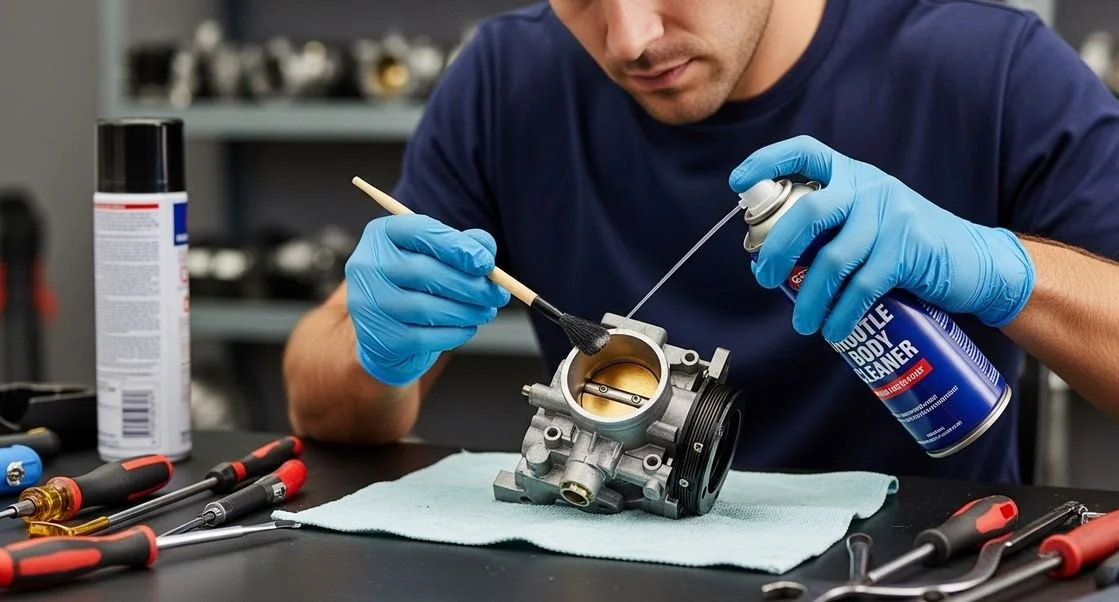
Carburetor cleaner is the best throttle body cleaner alternative you’ll find.
It is designed to eat through heavy varnish and lead deposits that you’d find in an old-school fuel system, which means it is incredibly effective at melting away carbon.
However, you need to use a light touch here because many modern throttle bodies have a special "molybdenum" coating on the butterfly valve that helps it seal perfectly.
If you go too heavy with the carb cleaner, you might strip that coating right off.
This could lead to a sticky valve later down the road, so spray it on a rag first instead of drenching the whole unit.
Also Read: Coolant All Over Engine
#2 Isopropyl Alcohol (90%+)
For the people who want to play it safe and avoid harsh fumes, rubbing alcohol works great.
You want the 90% or 91% stuff because the lower concentrations have too much water, and we definitely don't want water hanging out in your intake manifold.
Alcohol is a fantastic solvent that breaks down oil and grease without being corrosive to the plastic or rubber bits that surround your throttle assembly.
Since it doesn’t come in a pressurized aerosol can, you won't get that "blasting" action to clear out the dirt, but if you dampen a microfiber cloth and give the bore a good internal scrub, you’ll be amazed at how much black soot comes off on the rag.
#3 Brake Cleaner
Brake cleaner can also be used as an alternative to throttle body cleaner.
However, it must be the non-chlorinated version, usually found in the green can.
The chlorinated stuff contains chemicals that can actually turn into a toxic gas if they get burned inside your engine, and it is also notorious for eating through rubber seals like they are made of sugar.
Even with the non-chlorinated version, you should be a little bit cautious about getting it on any electrical connectors or plastic sensors attached to the side of the throttle body.
It dries incredibly fast and leaves zero residue, which is exactly what you want,
But just remember that it’s a dry solvent, so it offers no lubrication for any moving pivot points.
Also Read: How Long Will 3mm Brake Pads Last?
#4 Denatured Alcohol
If you happen to be a woodworking hobbyist or a painter, you might have a tin of denatured alcohol sitting in the corner, and it works remarkably well for this specific job.
It is quite similar to isopropyl alcohol in how it behaves, but it is a bit more industrial-strength when it comes to dissolving the "gum" that forms from oil vapors.
It evaporates almost instantly, leaving the metal surfaces bone-dry and clean, which is a major plus for your engine's sensors.
I like using a cotton swab dipped in this stuff to get into the tiny hinges where the butterfly plate rotates, as that is usually where the most stubborn gunk likes to hide and cause your gas pedal to feel "notchy" or stiff.
#5 Acetone (Metal Parts ONLY)
Acetone can also be used as a throttle body cleaner substitute.
This stuff is the ultimate cleaner, but it is also a total loose cannon because it will dissolve almost any plastic or paint it touches in a matter of seconds.
If you have removed your throttle body from the car and it is a 100% metal housing with no plastic bits attached, then acetone will make it look brand new in about thirty seconds.
But if you have a modern car with an electronic throttle body that has a plastic motor housing built into it, keep the acetone far away.
It is just too risky to use as a spray-and-wipe while the part is still attached to the car, as .
One accidental drip could melt a hole in a vacuum line or a plastic sensor cover.
Also Read: Green Brake Fluid
#6 Electrical Contact Cleaner
You might have a can of "QD Electronic Cleaner" for fixing sticky buttons or cleaning up battery terminals, and it is actually a very safe, gentle alternative for your throttle body.
It is specifically formulated to be safe on every type of plastic and rubber known to man, so you don't have to worry about ruining your expensive sensors.
The trade-off is that it isn't a very strong degreaser.
So you are going to have to spend a lot more time scrubbing with a toothbrush to get the carbon to budge.
It’s the perfect choice for someone who is terrified of damaging their car and doesn't mind putting in a little extra physical effort to get that shiny metal finish.
#7 Intake Cleaner Sprays
Finally, we have intake cleaner sprays, which are basically the exact same thing as throttle body cleaner just wearing a different hat.
If the can says "Fuel Injection Air-Intake Cleaner," you can use it with total confidence because it is designed for the exact same environment.
These sprays are usually formulated to be "oxygen sensor safe," which is a big deal since all those chemicals eventually have to blow out through your exhaust.
If you find this in your garage, stop looking for alternatives and just use it, as it is the closest you can get to the "official" product without actually buying the one labeled "throttle body cleaner."
Also Read: Ran Over A Skunk
What NOT To Use
Now let’s talk about what you absolutely should not spray inside your throttle body. This is where people get into trouble. Don’t ever use these:
Oven cleaner
Vinegar or household acids
WD-40 as a cleaner
Gasoline
Paint thinner or mineral spirits
Strong degreasers not rated for automotive intake parts
These products can damage protective coatings, destroy sensors, swell rubber seals, or leave behind residue that causes more problems than the carbon buildup you were trying to fix.
Just because something removes grease doesn’t mean it belongs inside your intake system.
If you wouldn’t spray it near delicate electronics, it probably doesn’t belong there.
Bottom Line
The best throttle body cleaner alternative is carburetor cleaner because it’s formulated to remove similar carbon and fuel deposits and works well on most throttle bodies.
Intake cleaner sprays are a close second and are often nearly identical in purpose.
Isopropyl alcohol and denatured alcohol work for light maintenance cleaning but struggle with heavy buildup. Brake cleaner can work but must be used carefully due to its strength.
Acetone should only be used on removed metal parts and never on assembled throttle bodies.
Electrical contact cleaner is safer around sensors but less effective on thick carbon.